

Table of Contents
Introduction: what are we doing here?
An Overview
At a Glance [Metaphysics, Epistemology, Ethics, Politics, Aesthetics]
The Project is a work-in-progress. This page is alive and will continue to evolve as the Project unfolds.
Introduction: what are we doing here?
Reality is given. It is unified. It is unique. Being simply is.
Starting from that fundamental assertion, we recognise that every philosophical and mystical Tradition must itself be an attempt to describe, cognise, interpret, or participate in Reality itself.
The Moon remains. We are simply awestruck astronomers pointing at it.
Traditions vary in tone, image, doctrine, ritual, and discipline. This variation follows from the multiplicity through which the Divine manifests at lower registers of Reality: in language, society, geography, habit, body, law, and world.
Every age, time, and place, therefore receives the Truth in a form most appropriate to the circumstances.
Every age, therefore, requires its own articulation of the Truth. Its own re-enchantment of Reality.
This is an articulation for ours.
We do not do as the Greats did. We seek what they sought.
The Overview
The Absolute is like Light.
The Principles of Reality are its rays.
Symbols (all extant objects, imaginal or physical) are the coloured glass through which those rays descend.
Interpretation is the act of apprehending the Light through the glass.
Knowledge is the self altered by the light it apprehends.
Virtue is the cleaning of the glass, its orientation to the Light.
Project Schematic
Importantly, this Project will pay homage to the emanative, hierarchical character of Reality that it presents by being structured emanatively itself.
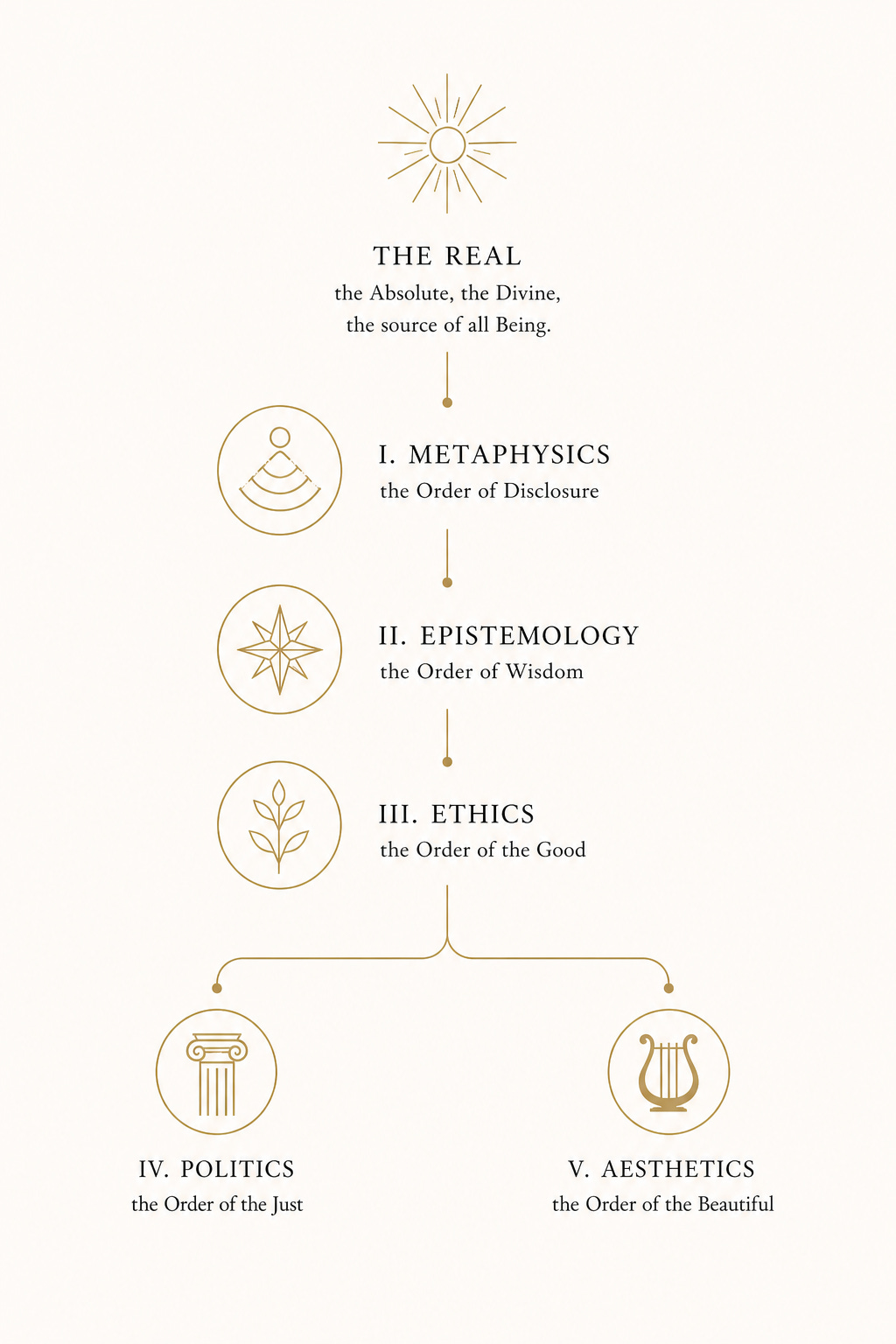
A complete philosophy must result in cogent and compelling answers for each of the five principal branches of philosophy:
Metaphysics: what does it mean to be?
Epistemology: how can we know what is?
Ethics: what is Goodness?
Politics: what is Justice?
Aesthetics: what is Beauty?
This Project proposes that:
The world is a hierarchy of symbols grounded in the Absolute.
To know a symbol truly is to participate in, and therefore, be transformed by the principle it discloses.
To act well is to clarify the symbol’s relation to that principle: the alignment of a symbol to its purpose.
Man is unique as the symbol capable of interpreting and clarifying other symbols.
Sanctity is thus the annihilation of false selfhood and the return of the self as simply a transparent witness to Being itself.
Life must be alchemised by orienting its norms, structures, images, narratives, and institutions towards the principles they’ve forgotten.
At a Glance
[Politics] A Genealogy of Anti-Modernity: what is the matter with the World?
[Metaphysics] Only when a Man dies, does he Awake: consider the symbolic nature of Reality.
[Epistemology] Not Objectivity, but Annihilation: what does it mean to know? When does data become wisdom?
[Epistemology] Philosophy is the Poor Man’s Poetry: what are the limits of what we can say about the Real?
[Epistemology] From Semantics to Reality: what are the logical foundations of these limits to what we can say?
[Metaphysics] The Grammar of Disclosure: what are the intelligible structures of Reality’s disclosure?
[Ethics] Behold! Bear Witness: what is the meaning of life? The telos of existence?
[Metaphysics/Ethics] The Structure of Nirvana: what is the culmination of this purpose?
[Ethics/Aesthetics] The Taste of Light: how does this culmination manifest in different traditions?
Chapter Overviews
A Genealogy of Anti-Modernity outlines:
modernity’s severance from transcendence, telos, symbolic depth, and spiritual order
the four major anti-modern responses:
Traditionalism: Truth but no Agency
Realism: Clarity but no Hope
Re-Enchantment: Vigour but no Justice
Immanentism: Temperance but no Ambition
the need for an alchemy of modernity: neither retreat nor surrender, but transfiguration
the Project’s governing movement: from the Divine, to knowing, to transformation, to society, to the City
Only when a Man dies, does he Awake outlines:
Reality is symbolic by nature: contingent things borrow being from higher principles and therefore disclose more than themselves.
Illusion means insufficiency, not falsehood: the world is real as disclosure, dangerous only when mistaken for self-subsisting Reality.
Every symbol has three moments: sign, source, and interpretant. Meaning is not complete until the interpreter is transformed.
Interpretation requires both horizontality, which clarifies particulars, and verticality, which ascends to essence, principle, and telos.
Good symbols possess clarity: fidelity to their source and humility before it. Bad symbols obscure, absolutise, or sever the sign from what it discloses.
Not Objectivity, but Annihilation outlines:
the need for a new epistemic standard, one that does not simply accumulate data, but expresses wisdom. It is not enough to “apprehend” a truth: one must additionally integrate that truth into you.
this higher objectivity is thus an expansion of the subject to truly integrate the meaning of the principle the symbol being interpreted represents
The Truth must have a bearing on who you are, and if it does not, it is not integrated. We call this bearing a collision with Reality.
higher objectivity is not arbitrary; it is constrained:
ontologically: symbols can only disclose what accounts for them
semiotically: false interpretations fail to deepen clarity, and coherence
existentially: interpretations must be positively reintegrated into the subject
aesthetically: Beauty is a hallmark of Truth
the canonical example of higher objectivity is love. Nobody can describe or elucidate or clarify what it means to fall in love. It is very real, very transformative, and very subjective.
Philosophy is the Poor Man’s Poetry discusses:
Language is necessary but dangerous: it clarifies Reality only when it remembers that it is symbol, not source.
Philosophical confusion arises from misplaced concreteness: treating concepts, abstractions, and words as if they were Reality itself.
The deepest truths cannot be possessed as propositions without mutilation. Language points, disciplines, and protects, but cannot contain the Real.
Myth is the highest form of history because it preserves meaning, telos, archetype, and participation, rather than merely arranging facts.
Poetry begins where philosophy ends: philosophy clarifies and prevents hallucination; poetry discloses, implicates, and invites transformation.
From Semantics to Reality specifies:
Formal reason is horizontally necessary and powerful, but vertically insufficient.
Syntax can manipulate symbols rigorously, but cannot determine their intended meaning by itself.
Model theory shows that coherent systems can admit multiple interpretations, including unintended ones; symbolic coherence is not yet contact with Reality.
There is no total description of Reality: truth always exceeds what can be said, proved, formalised, or modelled.
Verticality has two forms: semantic verticality, from syntax to meaning-in-a-model, and noetic verticality, from model to Reality itself, constrained by world-anchoring.
The Grammar of Disclosure introduces:
The principal axes along which to interpret symbols:
Gender:
Mercy: does the symbol open possibility?
Wrath: does the symbol necessitate outcome?
Clarity:
Fidelity: does the symbol faithfully represent its source?
Humility: does the symbol ever claim to be its source?
Register: the distance of a symbol from the Real, a measure of a symbol’s particularity or contingency
Virtue is the increase of a symbol’s clarity to higher register principles with an act of mercy or wrath. Vice is the opposite.
Virtue is thus an orientation of the symbols of Reality to the Divine, towards their true purpose.
Exoteric (manifest traditions) must participate in the Esoteric (divine wisdom) in order to have any purpose or meaning.
Behold! Bear Witness outlines:
the distinction between Being and Becoming
conscious life as the capacity to discern Being through Becoming
the difference between instrumental and contemplative apprehension:
the thing as tool
the thing as symbol
contemplation as the discovery of a thing’s essence, nature, and telos
the telos of conscious life as the clarification of Reality’s disclosure
shahadah as the highest form of witness: to behold Becoming and discern Being
The Structure of Nirvana outlines:
enlightenment as the extremal case of bearing witness
conscious life as barzakh: the bridge between the Divine and Creation
the fourfold path of clarificatory transformation:
Initiation: the self’s wrath on itself
Opening: the Real’s mercy on the self
Ascent: the Real’s wrath on the self
Return: the self’s mercy on the self
all virtuous action as a fractal repetition of this path
the claim that there is no liberation without virtue
sin as cognitive failure: misapprehended purpose decaying into distorted being
The Taste of Light outlines:
the differing representations of mystical experience across traditions
the danger of crude perennialism; the need for a precise typology
3 axes of mystical representation:
Silence vs Radiance
Annihilation vs Saturation
Sobriety vs Ecstasy
that contact with the Real is one at the highest register, but plural in symbolic representation
the way cultures, geographies, temperaments, and traditions shape the imagery of enlightenment
mystical traditions as prisms: Zen as cut, Taoism as flow, Islam as flame and light, Christianity as wound, Neoplatonism as flight
En fin, this Project is an act of devotion, offered up in the Name of the Divine and in honour of the Holy Prophet.
From Him do we come, and unto Him do we return.